
Poland is one of Europe’s fastest-growing e-commerce markets, and for a Shopify store in Germany, Sweden, the UK, the US or the Netherlands, it is an obvious next market. The shoppers are there, shipping is manageable, and Shopify makes adding a market a few clicks. The temptation is to switch on automatic translation, watch Polish appear on your product pages, and call it done.
That is where a lot of stores quietly lose the sale. Polish is one of the harder languages for machine translation to get right, and Polish shoppers spot machine-made copy instantly. This guide covers why that happens, what good Polish product copy actually looks like, and how to localize a Shopify store into native-quality Polish without guessing.
Why Polish breaks automatic translation
Polish is a heavily inflected Slavic language, and a handful of patterns trip up generic translation again and again:
- Gender and agreement. Every noun has a gender, and adjectives have to agree with it. “Serum” is neuter in Polish, so “moisturising serum” is nawilżające serum, not nawilżający serum. Machine output flips these constantly.
- Seven grammatical cases. Polish noun endings change depending on the word’s role in the sentence (mianownik, dopełniacz, celownik, biernik, narzędnik, miejscownik, wołacz). Use the wrong case and the sentence reads broken to a native speaker.
- Calques. Literal English compounds turn into nonsense. “Cruelty-free” should be nietestowane na zwierzętach, never a word-for-word okrucieństwo-wolne. Auto-translate loves to invent these.
- Formality. Polish separates formal address (Pan/Pani) from informal (Ty). A casual English imperative translated literally can land as either stiff or oddly blunt, depending on context.
- Capitalization. English Title Case does not exist in Polish. “Natural Face Cream” should be Naturalny krem do twarzy, with a capital on the first word only. Title-cased Polish is an instant tell that the page was auto-translated.
Why “good enough” Polish costs you sales
Shoppers read trust into language. Copy that is grammatically off, or that uses the wrong level of formality, signals that the store is foreign and maybe not safe to buy from. In a market where local competitors write fluent Polish, “good enough” translation is a conversion leak you cannot see directly. It does not throw an error, it just shows up as a weaker conversion rate on your Polish traffic. The fix is not more machine translation. It is making sure no machine output reaches a shopper without a human checking it first.
How to localize a Shopify store into Polish
The mechanics inside Shopify are straightforward:
- Add Polish as a language under Settings → Languages → Add language, and publish it so shoppers can see it.
- Translate your product titles and descriptions (plus collections, pages and theme text) into the
pllocale. Shopify stores these through its built-in Translations system. - Review before you publish. This is the step most stores skip, and the one that matters most.
For the translation itself, you have three broad options:
- Generic auto-translate apps. Fast and cheap, but they produce exactly the robotic Polish described above, and they usually push it straight to your storefront unchecked.
- Professional human translation. Accurate, but slow and expensive, and awkward to keep in sync every time your catalog changes.
- AI translation with a human review step. The middle path. AI does the heavy lifting, tuned for Polish, and you approve or edit before anything goes live.
Entering Poland properly is also a compliance question, not just a language one. If you are taking Polish traffic you will need a RODO (GDPR) cookie banner that actually blocks trackers until consent, which is what our ConsentPL app handles. But the storefront copy is what shoppers judge first.
A faster way: Polished
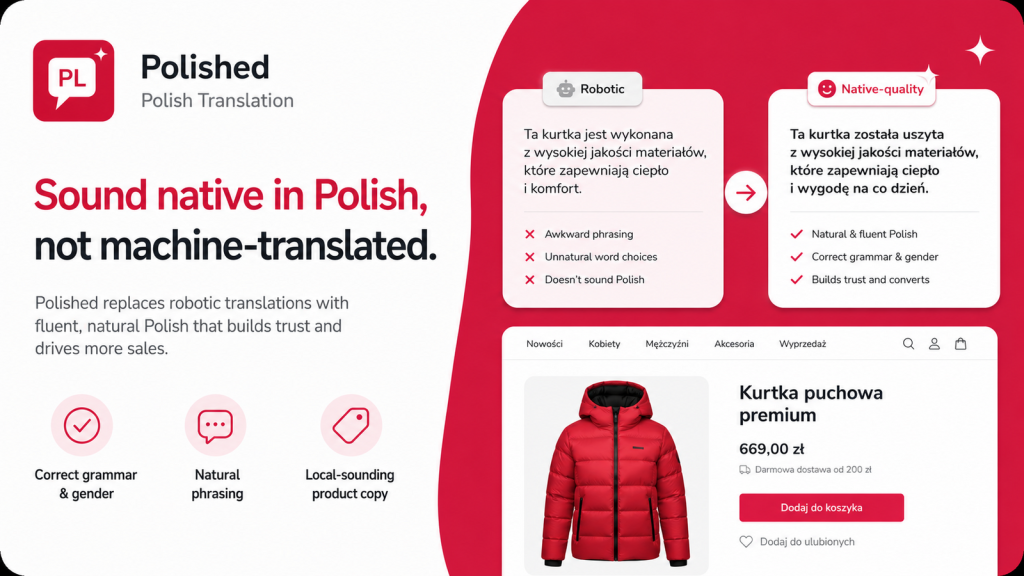
We built Polished for exactly this situation: foreign stores entering Poland, and Polish agencies localizing clients’ stores. It translates your product titles and descriptions into native-quality Polish, and it is built around the rules above:
- AI tuned for Polish grammar: the seven cases, gender agreement, and Polish (not English) capitalization.
- A tone selector, formal, neutral or casual, so the Polish matches your brand voice (Pan/Pani or Ty).
- A glossary, so your brand names, key terms and product wording translate the same way every time.
- Brand names, SKUs, URLs and product codes are preserved automatically.
- Quality flags that surface robotic tone, wrong formality or overly literal output, so you know what to check.
- A mandatory review-and-approve step. Nothing publishes until you sign off, and re-translating never overwrites your manual edits.
- Approved copy saves straight into Shopify’s native Translations for the Polish locale. No theme edits, no second storefront.
There is a 14-day free trial, so you can translate and review your real catalog before paying anything.
FAQ
Is Shopify’s automatic translation enough for Poland?
For a rough first draft, yes. As your shopper-facing copy, no. It produces the gender, case and calque errors above, and it publishes without review. Treat it as a starting point you correct, not a finished translation.
Do I need a native Polish speaker?
For a final pass on your most important pages, it helps. But a tool tuned for Polish that forces a review step gets you most of the way there at a fraction of the cost, and a native reviewer or a Polish agency can then approve rather than translate from scratch.
Should my Polish copy be formal or informal?
It depends on your brand. Beauty, fashion and youth brands often use the informal Ty. More traditional or premium categories lean formal (Pan/Pani). The key is to pick one and stay consistent, which is exactly why a tone setting matters.
Poland is worth doing properly. Native Polish copy is the difference between looking like a local store and looking like a foreign site running everything through a translator. Get the language right, and the market opens up.
Polished
Translate your Shopify store into native-quality Polish with AI, then review every translation before it publishes. Tone control, glossary, 14-day trial.
Install Polished on Shopify →See full app details