
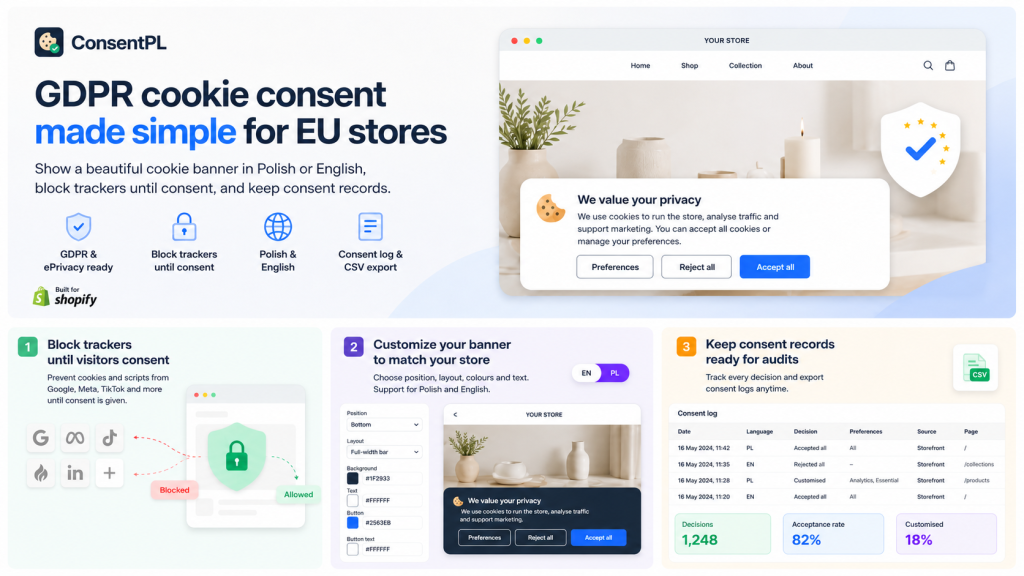
Shopify added a built-in cookie banner a while back, and many merchants assumed that ticked the GDPR box. It did not. The banner shows the message and saves the shopper’s choice, but it does not stop Google Analytics, Meta Pixel, TikTok or Hotjar from firing the moment the page loads. By the time someone clicks “reject”, their visit has already been tracked.
That gap is the part that matters under GDPR, and it is the part the native banner does not close. For stores selling into the EU, especially Polish stores under UODO oversight, it is also where the legal risk lives.
What Shopify’s cookie banner actually does
The native banner does three things. It shows a notice. It records the shopper’s preference. It surfaces that preference to Shopify’s own analytics and to the merchant.
Everything else, the cookies and tracking scripts you added in the theme or via the marketing and ads section, runs on the standard page load. Shopify does not hold those scripts back until consent is given. Most merchants discover this when their dev tools show Google Analytics firing on a fresh visit, before the banner has even been clicked.
What is still firing before consent
On a typical Shopify store with marketing turned on, here is what runs the moment a visitor hits the page:
- Google Analytics (GA4). Pageviews, sessions and demographics are collected immediately.
- Meta Pixel. A pageview event fires for retargeting and conversion attribution.
- TikTok Pixel. Same pattern, same first-load timing.
- Hotjar, Microsoft Clarity, and similar session-recording tools. Recording begins on the first paint.
- Theme-installed scripts. Heatmaps, A/B testing and similar that you added to the theme code over time.
Even if the shopper then clicks “reject”, their data was already collected for the first few seconds. That window is exactly what GDPR was written to prevent.
Why this matters for EU stores
GDPR requires prior consent for any non-essential tracker. “Prior” is the key word. A banner that informs you, then lets a script fire anyway, does not satisfy the rule.
Three things keep this practical rather than abstract. Polish UODO, German DSB and French CNIL are actively issuing fines, especially for analytics and ad pixels firing without consent. Customer complaints are easy to file and routinely trigger investigation. And ad platforms like Google now require Consent Mode v2 signals, so an improperly configured store loses measurement quality on top of the legal exposure.
For most merchants the immediate risk is not a headline fine. It is the slow accumulation of compliance debt that becomes a problem the next time the store grows, gets reviewed, or comes up in due diligence.
What a proper consent banner does differently
A compliant consent layer does the opposite of Shopify’s native banner. The default state is blocked. Trackers are held until the shopper accepts. If they decline, the scripts never run. If they accept some categories and not others, only the accepted scripts fire.
The useful pieces are:
- Default-block for tracking scripts. Google, Meta, TikTok and Hotjar held until consent.
- Google Consent Mode v2. Keeps ad measurement working after consent, so your campaigns still attribute properly.
- Theme tracker scan. Finds the scripts you forgot you added and gates them too.
- Granular categories. Necessary, analytics, marketing, preferences. The shopper picks, not just yes or no.
- Audit-ready consent log. A CSV record of who consented to what, in case anyone ever asks.
How to add proper consent without code
You do not need a developer or a separate consent management platform to do this on a small store. ConsentPL, our GDPR cookie banner for Shopify, installs as a theme app embed and holds Google Analytics, Meta Pixel, TikTok and Hotjar until the shopper consents. It supports Google Consent Mode v2 so your ad measurement keeps working after consent, scans your theme for tracking scripts you may have added years ago, and logs every consent for audit purposes.
The banner ships in Polish and English with editable colours, text and position. There is a free plan with the basics, and a Pro tier at $4.99 a month with Consent Mode v2 and the theme tracker scan. You can install ConsentPL from the Shopify App Store and be GDPR-compliant in minutes.
Which stores need this most
Any store selling into the EU needs proper consent management. The risk is concentrated for a few groups:
- Polish merchants. UODO is one of the more active enforcers in the EU and Polish consumers know how to file complaints. A Polish-first banner avoids the awkwardness of an English-only consent flow on a Polish storefront.
- Stores running paid ads. Google Consent Mode v2 is required for ad measurement to keep working post-consent. Without it, campaigns lose attribution.
- Stores with multiple trackers. The more scripts you have running, the more visible the gap between “the banner shows” and “the trackers fire anyway”.
- Stores planning to sell or raise. Compliance debt is a flag in due diligence. Cleaning it up before that matters.
The takeaway
Shopify’s built-in banner is a notification, not a tracking block. Google Analytics, Meta Pixel, TikTok and Hotjar all run before the shopper has agreed, which is exactly the thing GDPR was written to stop. A proper consent layer holds those scripts until consent, supports Google Consent Mode v2 so your ads keep measuring, and gives you an audit log for the regulator nobody wants to meet. If your store sells into the EU and you would rather be compliant than hopeful, ConsentPL is built to close the gap.
ConsentPL
Blocks Google, Meta, TikTok and Hotjar until shoppers consent. Polish and English, free plan available.
Install ConsentPL on Shopify →See full app details